

Cart
0
Understanding Kojic Acid, Niacinamide and Alpha Arbutin
A good skincare routine doesn't end with cleansing your face. What you apply before going to bed can also play an important role in maintaining skin hydration and addressing specific skin concerns.
Night creams are designed to moisturise the skin, support its natural barrier and, depending on their formulation, deliver ingredients that target concerns such as dullness and uneven skin tone.
If you're looking for a night cream for dark spots or pigmentation, understanding its ingredients is just as important as choosing the product itself.
Let's look at what makes a night cream useful and explore three ingredients commonly found in brightening skincare formulations.
Why Do You Actually Need a Night Cream?
You might be wondering: Can't I just use my daytime moisturizer at night? You can, but you'd be missing out on an important purpose of the cream. Night creams are specifically formulated to support your skin’s natural overnight regeneration process.
Adding a targeted night cream to your routine provides three major benefits:
-
Deep Hydration: As you sleep, your skin loses more water than it does during the day. A good night cream replenishes this moisture, keeping your skin plump and soft.
-
Skin Barrier Repair: Moisturizing ingredients help rebuild your skin’s protective barrier, making it more resilient against breakouts and environmental damage.
-
Targeted Treatment: Nighttime is the perfect opportunity to deliver active ingredients like Kojic Acid and Niacinamide, without worrying about sun sensitivity or makeup pilling.
Three Ingredients Worth Knowing About
When choosing a dark spot removal cream, understand what its active ingredients actually do.
1. Kojic Acid
Kojic acid is commonly used in skincare products formulated for pigmentation and dark spots.
It works by inhibiting tyrosinase, an enzyme involved in melanin production. Excess melanin production in certain areas can contribute to visible pigmentation.
According to researches:
A randomized, single-blind comparative study published in the Indian Journal of Dermatology investigated kojic acid in 80 patients with melasma.
Participants using 1% kojic acid cream showed improvement in pigmentation over 12 weeks. The study also found that combining kojic acid with hydroquinone produced a stronger response.
The researchers identified kojic acid's depigmenting potential through its inhibition of tyrosinase and suppression of melanin production.
This supports its use in pigmentation-focused skincare, although results from a particular study formulation cannot be directly applied to every kojic acid cream.
2. Niacinamide
Niacinamide, also known as vitamin B3, is a versatile skincare ingredient.
It helps support the skin barrier, improves moisture retention and can reduce the transfer of melanin-containing structures to surrounding skin cells.
According to researches:
A 2002 study published in the British Journal of Dermatology examined niacinamide's effects on pigmentation.
The researchers conducted clinical trials involving women with facial hyperpigmentation and found that niacinamide significantly reduced pigmentation compared with the control moisturiser.
The study concluded that niacinamide works partly by inhibiting melanosome transfer from pigment-producing cells to surrounding skin cells.
One of its key findings was that niacinamide use "significantly decreased hyperpigmentation" after four weeks in the clinical studies.
This makes niacinamide an interesting ingredient for formulations targeting uneven skin tone, while also offering skin barrier support.
3. Alpha Arbutin
Alpha arbutin is another ingredient commonly found in brightening serums and creams.
It works by inhibiting tyrosinase activity, helping regulate melanin production. This makes it a popular ingredient in formulations targeting the appearance of dark spots and uneven pigmentation.
According to researches:
A 2025 pilot study published in the Journal of Cosmetic Dermatology examined a formulation containing 5% alpha arbutin and 2% kojic acid in 30 participants with melasma.
The treatment was evaluated over 12 weeks and compared with a conventional triple-combination cream.
The researchers reported improvements in melasma measurements with the alpha arbutin and kojic acid formulation. The study also found a lower recurrence rate compared with the alternative treatment.
The authors concluded that the formulation "appeared to be effective for melasma treatment."
However, this was a small pilot study, and the findings apply to the specific combination and concentrations tested, not to all alpha arbutin products.
Why did we combine these three ingredients?
Kojic acid, niacinamide and alpha arbutin have different roles in skincare.
|
Ingredient |
Primary role |
|
Kojic acid |
Targets the appearance of pigmentation |
|
Niacinamide |
Supports the skin barrier and even-looking skin |
|
Alpha arbutin |
Helps address excess pigmentation |
Combining these ingredients in one formulation can make it easier to incorporate them into a skincare routine.
However, the presence of these ingredients alone does not guarantee results. Their concentrations, formulation stability and individual skin tolerance all matter.

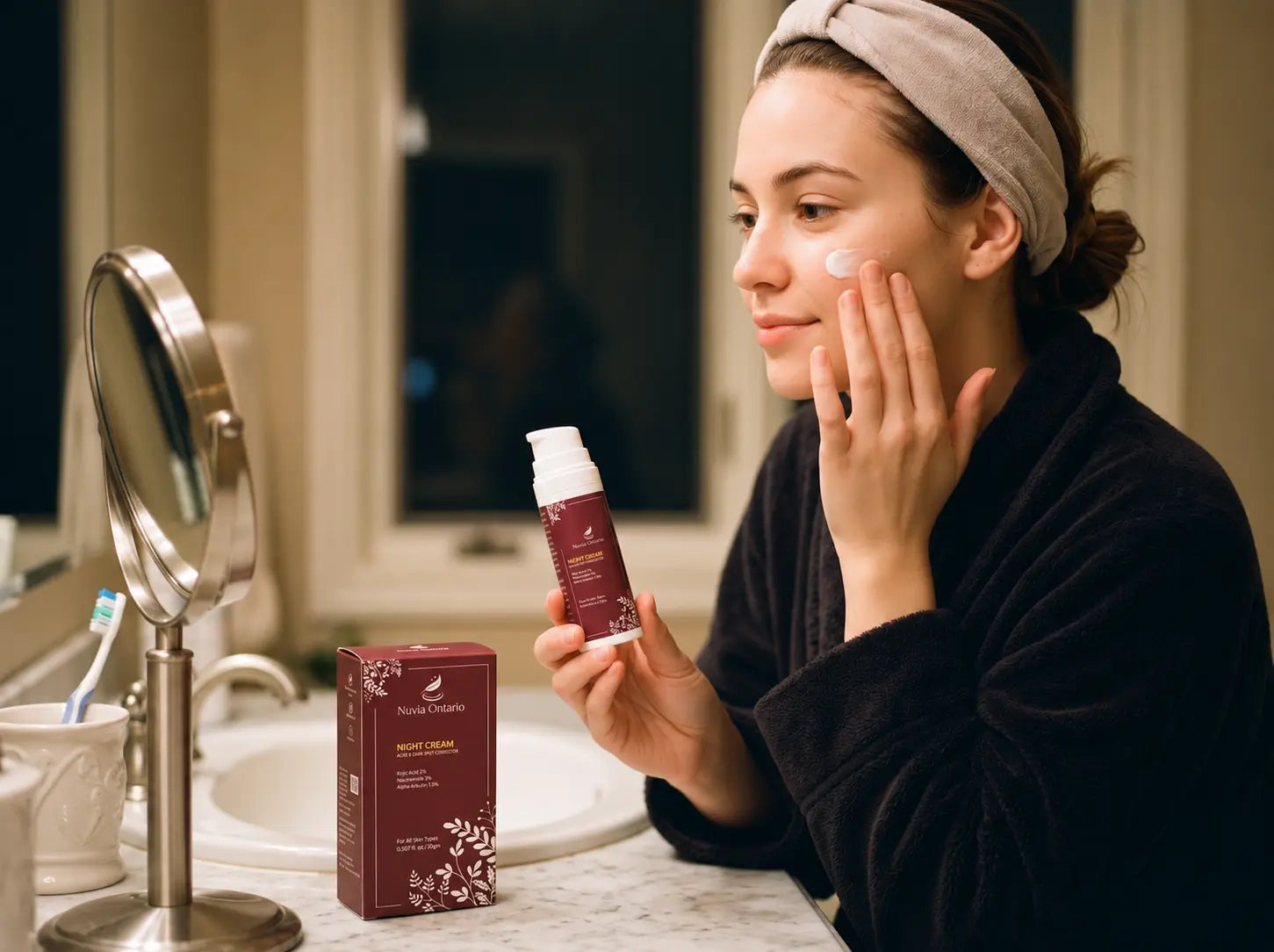
If you're considering a night cream that combines these three ingredients, Nuvia Ontario’s Night Cream has got you covered.
It is a lightweight, non-greasy overnight moisturiser formulated with kojic acid, niacinamide and alpha arbutin.
Our cream is designed to:
-
Moisturise and soften your skin.
-
Support a more even-looking complexion.
-
Improve the appearance of dullness and uneven skin tone.
-
Fit easily into an evening skincare routine.
It comes in a 30g pack and is suitable for all skin types and both men and women.
How to Use a Night Cream
A simple routine is often enough. Here's how to incorporate a night cream into your evening skincare:
-
Cleanse: Wash your face with a gentle cleanser.
-
Apply: Take a small amount of Nuvia Ontario’s Night Cream and spread it evenly over your face and neck.
-
Massage: Gently massage until it absorbs beautifully into your skin.
-
Leave overnight: Allow the moisturiser to remain on your skin.


